In the neighborhood of El Terreno, at the foot of the Bellver forest, several apartment blocks were built at the end of the 1970s, motivated by the incipient tourism and the boom in the area. These are buildings that in themselves are nothing special, and in fact break the urban fabric of single-family houses, but which house bright homes with privileged views of the bay.
One of these buildings is El Escala, where we were tasked with merging two 40 m² apartments to meet the needs of a family.
The original layouts were highly compartmentalized, with low-quality materials and a thermal envelope lacking insulation.
From the beginning, the need for a full renovation of the home is established.
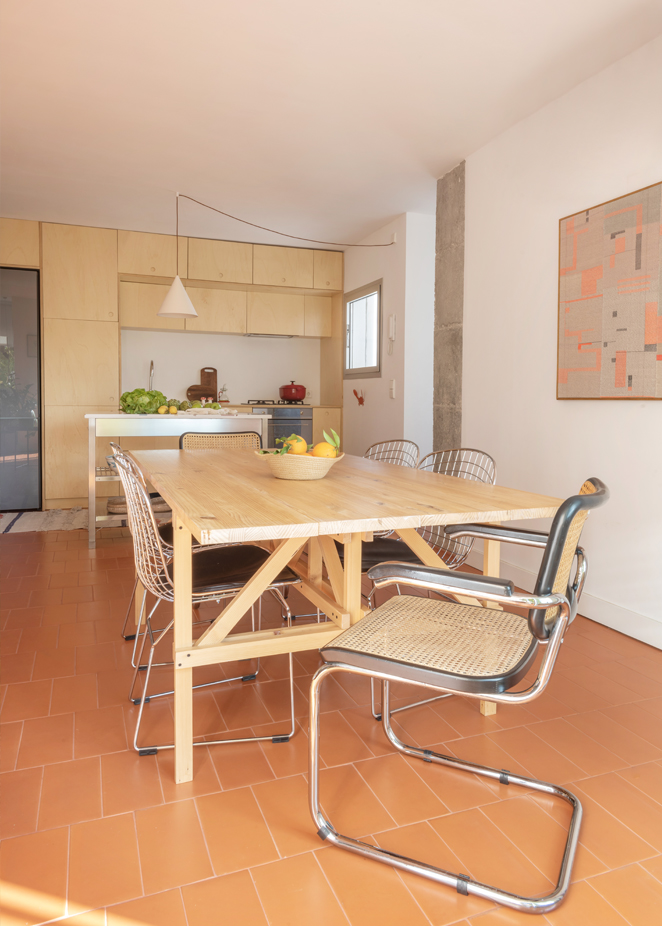
The intervention aims to maximize the sense of spaciousness, in contrast to the previous fragmented layout. The design favors an open-plan space that integrates the living room, kitchen, and dining area, eliminating hallways and residual areas to optimize every square meter.
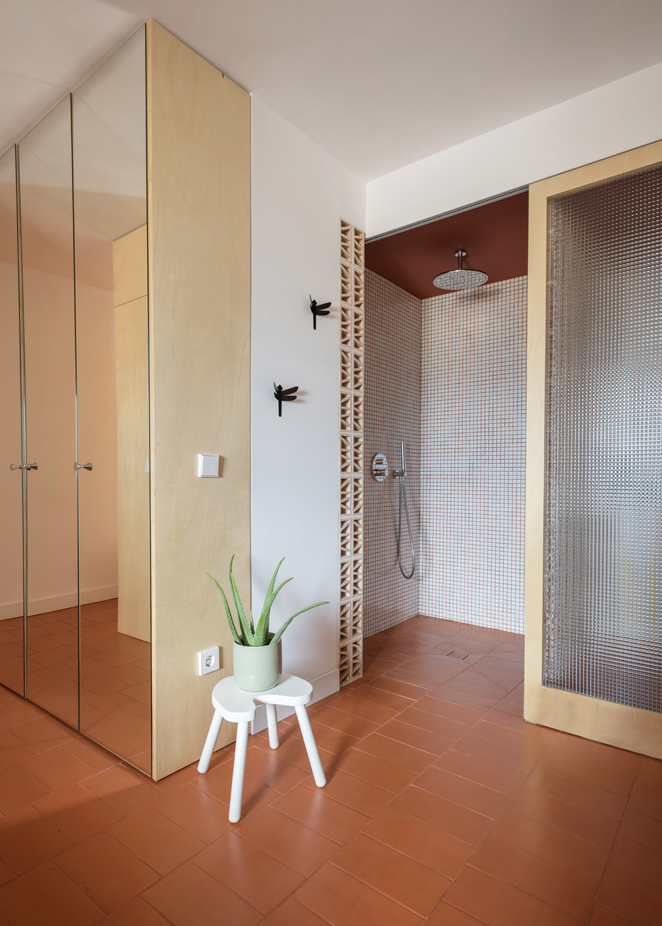
The house is structured by a birch wood cabinet from floor to ceiling that becomes the axis of distribution and storage of the same.
The kitchen, simple yet functional, blends seamlessly into the dining space.
The design also incorporates a multi-purpose room with movable partitions, allowing the space to adapt to different needs. This area can function as an office, playroom, or guest bedroom, ensuring its active use within the eighty square meters of available space.
The selected materials are closely linked to the Mediterranean style of the project.
The Catalan tile floor is like a large carpet that covers everything, including the shower trays. The use of ceramic louvers at various strategic points allows light to pass through but prevents direct vision between spaces. The pillars are stripped to expose the concrete with its imperfections. The warmth of the space is achieved through natural-toned birch wood, which will develop a richer hue over time.
The warmth of the space is achieved through natural-toned birch wood, which will develop a richer hue over time.
Several improvements to the energy efficiency of the house were proposed, incorporating interior insulation in the facades and air conditioning the spaces with more efficient systems. It is essential to move towards an efficient and bioclimatic architecture, using healthy materials and solutions that contribute to well-being.